Knit and purl
The knit stitch and the purl stitch are the two building blocks of almost everything you will knit. Learn both, see how they combine, and finish with a bind off.
Updated
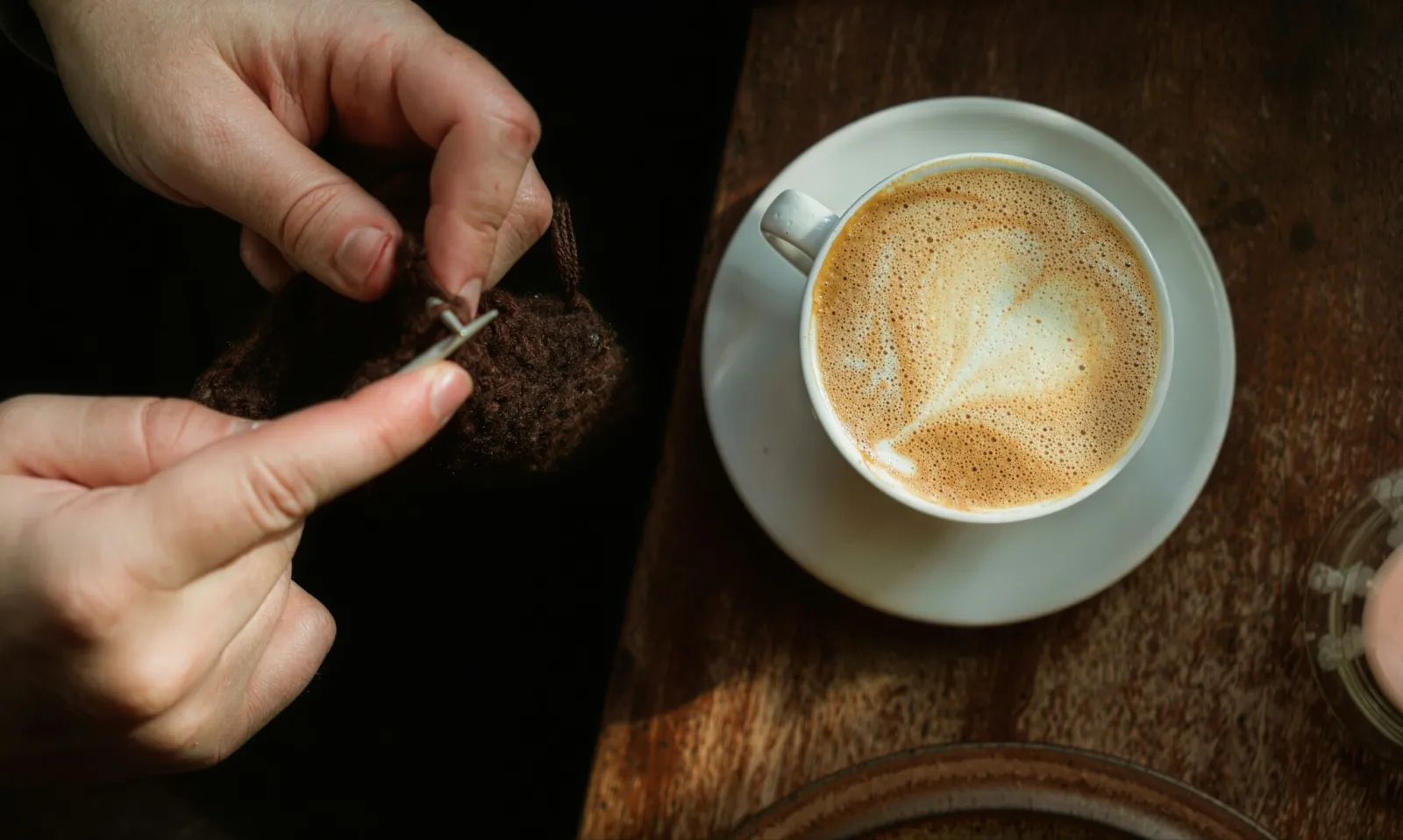
Almost all knitting is made from two stitches: knit and purl. Learn these and you can make scarves, hats, blankets and most of what comes next. This guide teaches both, explains how they combine into fabric, and ends with binding off.
Holding the needles and yarn
Hold the needle with the stitches in your left hand and the empty needle in your right hand. The yarn comes from the ball to the back of your work. Wrap it around your right index finger, or hold it in your left hand, whichever feels natural. Keep your grip loose. Tight hands make tight stitches.
The knit stitch
- Put the tip of the right needle into the first stitch on the left needle, from front to back. The right needle crosses behind the left.
- Wrap the yarn around the right needle, going from back to front.
- Pull the right needle back through the stitch, taking the new loop with it.
- Slide the old stitch off the left needle. You now have a new stitch on the right needle.
Repeat across the row. When all the stitches have moved to the right needle, swap the needles between your hands and begin the next row.
Gordon’s tip: Talk yourself through it. “In, around, through, off.” Gordon has watched many knitters mutter this under their breath.
The purl stitch
The purl stitch is made with the yarn held at the front of the work.
- Bring the yarn to the front, between the needles.
- Put the tip of the right needle into the first stitch on the left needle, from back to front. The right needle sits in front of the left.
- Wrap the yarn around the right needle, going from the top, over the front and down.
- Push the right needle back through the stitch, taking the new loop with it.
- Slide the old stitch off the left needle.
When you want to knit the next stitch after a purl, move the yarn back to the rear again. Forgetting this is the most common cause of a stray extra loop.
Garter and stockinette
Combine the two stitches in different ways and you get different fabrics.
- Garter stitch. Knit every row. The result has ridges on both sides, lies flat and stretches a little in both directions. It is forgiving and a very good choice for a first project.
- Stockinette stitch. Knit one row, purl the next. One side is smooth, with rows of little V shapes. The other side is bumpy. The edges tend to curl, so patterns often add borders to keep it flat.
- Ribbing. Alternate knit and purl stitches within a row, for example knit 2, purl 2. It stretches a lot and is used for cuffs and hems.
Garter ridges are a handy way to count rows. Each ridge, a little raised bump, is two rows.
Binding off
Binding off (casting off in British English) secures the last row so the knitting will not unravel.
- Knit two stitches.
- Using the left needle tip, lift the first stitch on the right needle over the second, and off the needle. One stitch remains.
- Knit one more stitch. Again lift the earlier stitch over it.
- Continue until one stitch is left. Cut the yarn, leaving a tail of about 15 cm, and pull it through the last loop.
Keep the bind off as loose as your cast-on. If it feels tight, use a needle one size larger for this row only. Some patterns ask you to bind off in the pattern stitch, which means knitting the knits and purling the purls as you go.
Practice
Cast on 20 stitches. Knit 10 rows in garter stitch. Then try 10 rows of stockinette: knit one row, purl one row. Count your stitches at the end of each row. Bind off loosely and weave in the ends. You now have a small swatch that shows both fabrics side by side.