What you need to start knitting
A short, honest shopping list for your first project: one pair of needles, one ball of yarn and a few small tools. Nothing else is needed on day one.
Updated
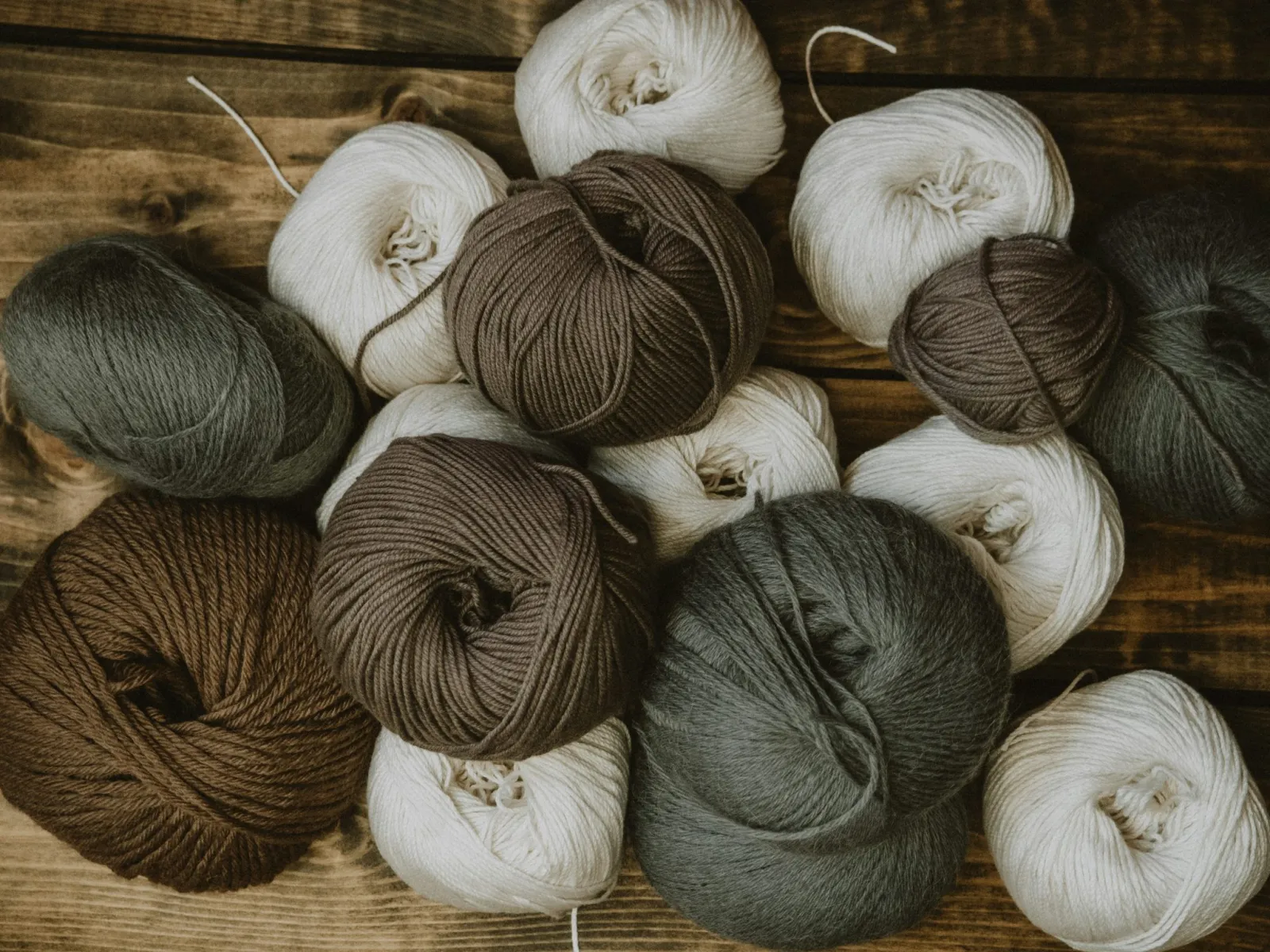
Knitting needs very little. You can start with a pair of needles, a ball of yarn and a pair of scissors. Everything else on this page is nice to have, and you can add it later when you know what you miss.
Yarn for your first project
Choose a yarn that is smooth, light in colour and not too thin. Light colours let you see each stitch clearly. Dark yarn hides mistakes, and that makes learning harder.
Look for these qualities:
- Medium thickness. A yarn sold as DK, worsted or aran is a good place to start. Very thin yarn is slow, and very thick yarn can feel clumsy.
- Smooth, firm strands. Avoid fluffy, hairy or loosely spun yarn for now. It splits easily and hides the stitches.
- Wool or a wool blend. Wool has a little stretch and grips the needles. Cotton is fine too, but it has less give and can be hard on the hands.
- Plain colour. Skip speckles and strong stripes until you are comfortable.
One ball of around 100 g is plenty for practice and a small first project such as a washcloth.
Needles
Needles come in sizes measured in millimetres. The yarn label usually gives a suggested needle size. Pick a size in the middle of that range.
For a first pair, a size between 4 mm and 5 mm suits most medium yarns.
Material is a matter of taste:
- Bamboo and wood are a little grippy. Stitches stay put, which helps beginners.
- Metal is smooth and fast. Stitches slide off easily, which can be frustrating at first.
- Plastic is cheap and light, but can feel slippery or bendy.
You will see three shapes. Straight needles have a point at one end and a stopper at the other. Circular needles are two points joined by a flexible cable. Double-pointed needles (DPNs) are short, with a point at each end, and come in sets of four or five for small rounds such as socks. You can use circulars for flat knitting too, and for knitting in the round you use circulars or DPNs.
Gordon’s tip: If you cannot decide, buy a pair of 4.5 mm bamboo needles and a ball of light-coloured DK yarn. Gordon says that is a fine place to begin.
Small tools worth having
You do not need these on the first day. They become useful quickly.
- Scissors. Small ones are fine. Do not bite your yarn.
- A tape measure. Soft and flexible, in centimetres and inches.
- A tapestry needle. Blunt, with a big eye, for sewing in the loose ends.
- Stitch markers. Small rings or clips that mark a spot in your work.
- A small crochet hook. It rescues dropped stitches.
- A notebook or an app. Write down your needle size, yarn and what you changed.
Reading the yarn label
The label is a small instruction sheet. Look for:
- Weight and length. For example 50 g and 125 m. The length matters more than the weight when you compare yarns.
- Needle size and gauge. The number of stitches and rows that make a 10 cm square.
- Fibre content. Wool, cotton, acrylic, or a mix.
- Care symbols. Whether it can go in the washing machine.
- Dye lot number. If you buy several balls, check that the numbers match. Different lots can vary slightly in colour.
A first practice
Once you have your yarn and needles, you are ready for the next guide, which teaches you to cast on. Here is a small goal to aim for: a plain square about 20 cm wide. It will teach you almost everything you need, and you can use it as a washcloth or a coaster.
Keep your first piece. In a few months you will look back at it and see how far you have come.